June 29, 2026
Square POS vs Shopify POS: Which Should You Run In Store?
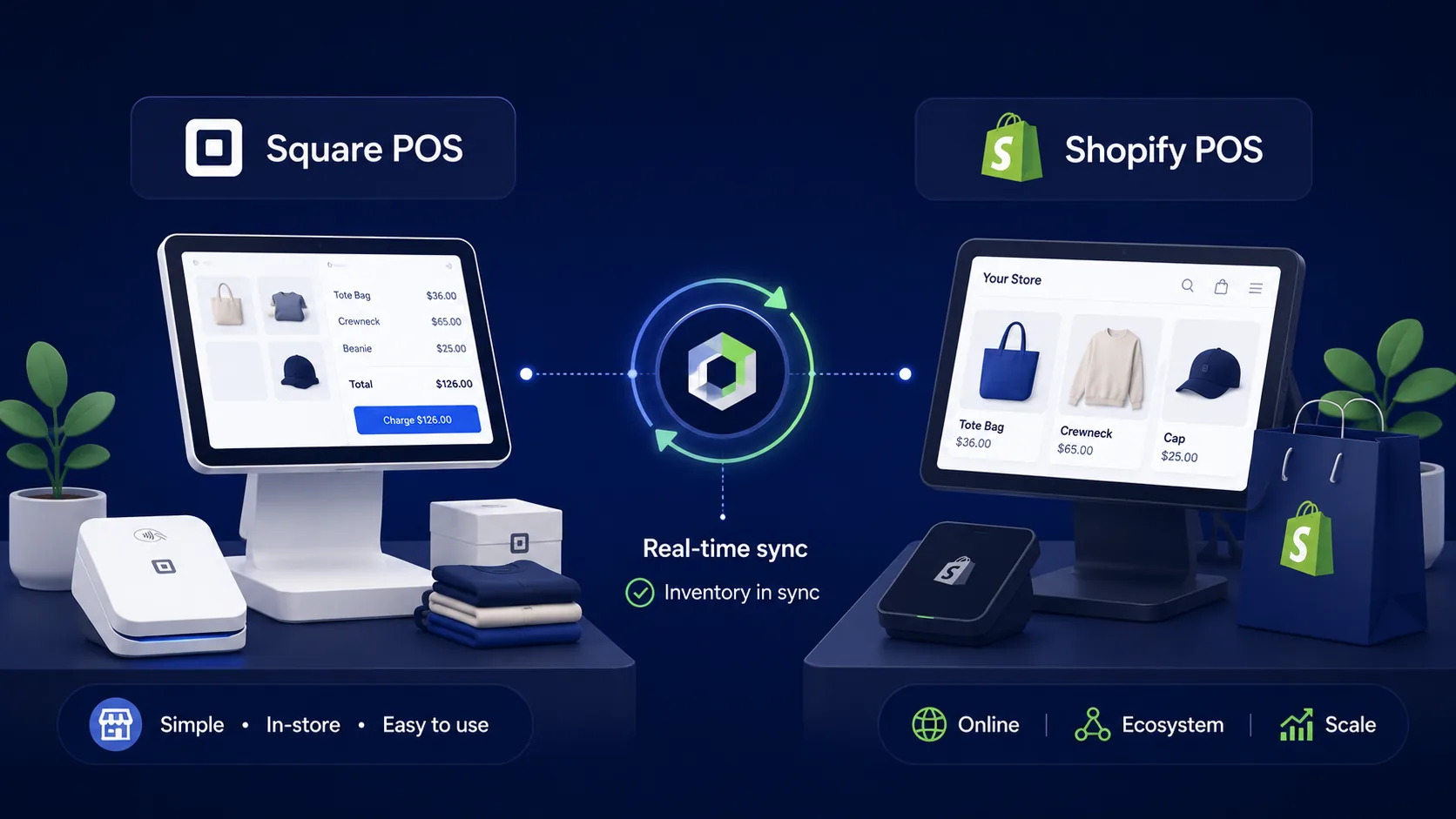
If you're opening a shop or rethinking your setup, the point-of-sale question comes up fast: Square POS or Shopify POS at the counter? Both are excellent, both are popular with independent retailers, and the honest answer isn't "one wins." It's "it depends on what your business already looks like" — and for a lot of stores, the best answer turns out to be both. Here's how to decide.
The short version
Square POS tends to win on simplicity and cost of entry for in-person selling. Shopify POS tends to win when your online store already runs on Shopify and you want one ecosystem. If you sell both in person and online — which is most retailers now — the real question isn't which to pick, but how to run the two together without your inventory falling apart. More on that below.
Square POS: simple, cheap to start, strong in person
Square earned its reputation by making in-person payments effortless. The POS app is free, the hardware is affordable and pay-as-you-go, and you can be taking card payments the same day with almost no setup.
It's a strong fit if: you're primarily a brick-and-mortar shop, you want low upfront cost, you value dead-simple setup, or your online presence is small or just getting started. Square's flat, transparent processing and no monthly minimum make it easy to predict what you'll pay.
Where it's limited: Square's built-in online store is fine for basics but isn't as deep as a dedicated ecommerce platform once your online business gets serious. Many growing retailers outgrow it online while still loving it at the counter.
Shopify POS: built around your online store
Shopify POS shines when Shopify is already running your website. Because it's the same platform, your products, customers, and orders live in one place across online and in-person — no second system to reconcile, at least within Shopify's own world.
It's a strong fit if: your online store is already on Shopify and meaningful to your revenue, you want one unified back office, or you need the deeper retail features on Shopify's higher plans.
Where it's limited: the cost is tied to a Shopify subscription, and the in-person experience and hardware can be a heavier lift than Square's grab-and-go simplicity. If your store is mostly in-person and your online side is light, you may be paying for ecommerce depth you're not using yet.
The choice most retailers actually face
Here's what the "Square vs Shopify" framing misses: plenty of successful independent retailers don't choose. They run Square at the counter because it's the best in-person experience, and Shopify online because it's the best storefront — and they get the strengths of both.
The catch is that Square and Shopify don't share inventory on their own. Sell the last item in store and your Shopify site has no idea; sell it online and your Square register never finds out. That's how you end up overselling and writing apology emails. (We cover this failure mode in detail in how to stop overselling.)
The fix is a Square Shopify integration that keeps the two in real-time, two-way sync — so a sale anywhere updates everywhere, automatically. Run that, and "Square POS vs Shopify POS" stops being an either/or. You use the best tool for each job and let the inventory take care of itself.
So which should you run?
- Mostly in-person, simple needs, cost-sensitive: Square POS, with Square's online store if you sell a little online.
- Serious online business already on Shopify: Shopify POS, for one unified system.
- Strong in both worlds (the common case): Square at the counter, Shopify online, connected with real-time inventory sync so they behave like one system.
If you're on BigCommerce online rather than Shopify, the same logic applies — here's how to connect Square to BigCommerce. And whichever way you go, line up your SKUs across both systems first, since that's what makes sync work — here's how to fix Square and Shopify SKU mismatches.
FAQ
Is Square POS or Shopify POS better for a retail store? It depends on your setup. Square POS is often the simpler, lower-cost choice for in-person selling; Shopify POS makes sense if your online store is already on Shopify. Many retailers run Square at the counter and Shopify online, then connect the two.
Can I use Square POS and sell on Shopify at the same time? Yes, and many merchants do — Square for in-person, Shopify online. The catch is they don't share inventory on their own, so you need a Square Shopify integration to keep stock in sync and avoid overselling.
Does Shopify POS cost more than Square POS? Generally Square has a lower barrier to entry — a free POS tier and pay-as-you-go hardware — while Shopify POS is tied to a Shopify subscription. Compare total cost across your in-person and online setup, not the POS alone.
If I use both Square and Shopify, how do I keep inventory accurate? With real-time, two-way sync between them, so a sale on either side updates the other within seconds. That's what keeps counts accurate and prevents overselling.
You don't have to pick the perfect POS — you have to make your tools work together. Connect Square and Shopify with OneKeepr and run the best of both without ever overselling. Your free trial runs for 7 days.